


Ritchie Nanda · 4 days ago · 7 min read
One platform to run your whole operation. Here's why it works.

There is a quiet shift happening across businesses that manage field teams, and it has very little to do with chasing the latest piece of software. It is a shift away from something much more familiar: the slow accumulation of disconnected tools that every growing business ends up running on, and toward a single, connected way of working.
WhatsApp for field updates. A spreadsheet for scheduling. Email for client correspondence. Slack or Teams for internal chat. Paper job sheets that someone eventually has to type up. None of these tools were chosen badly. Each solved a real problem at the time. But added together, they stop being a toolkit and start being the thing standing between a business and the visibility it actually needs.
This piece looks at why businesses are moving away from that fragmented setup, what they are replacing it with, and what that change actually looks like once it happens.
Why the shift is happening now
Operations leaders have talked about wanting "one source of truth" for years. What has changed recently is the pressure pushing them to actually act on it.
Field teams have grown more distributed, not less. A business managing ten people on one site can get away with a patchwork of tools. A business managing two hundred people across fifteen sites, with a mix of direct staff, subcontractors and freelancers, cannot. The informal systems that worked at a smaller scale simply stop holding together.
At the same time, the cost of admin has become harder to avoid. As wage and operating costs rise across nearly every sector, businesses are looking far more closely at how their managers actually spend their time. A manager spending several hours a week manually chasing updates, reconciling timesheets or compiling reports is a real, recurring cost. It is also one of the easiest costs to remove.
Clients and regulators are also asking for more proof than they used to. Whether that is a facilities client wanting evidence a site visit happened, an insurer requiring verified documentation, or a healthcare regulator expecting an accurate visit log, the bar for evidence has risen. A fragmented setup, where evidence lives across email threads and phone galleries, makes that proof slow and hard to produce convincingly.
And increasingly, safety expectations have shifted from optional to baseline. Lone worker protection used to be treated as a nice-to-have in many industries. Businesses without a structured way to track field teams and respond to incidents are now recognising that gap as a genuine liability, not just an inconvenience.
What businesses are actually replacing their old setup with
The businesses making this shift are not adding another tool to the pile. They are replacing the pile entirely with a single field operations platform built around how field work actually happens.
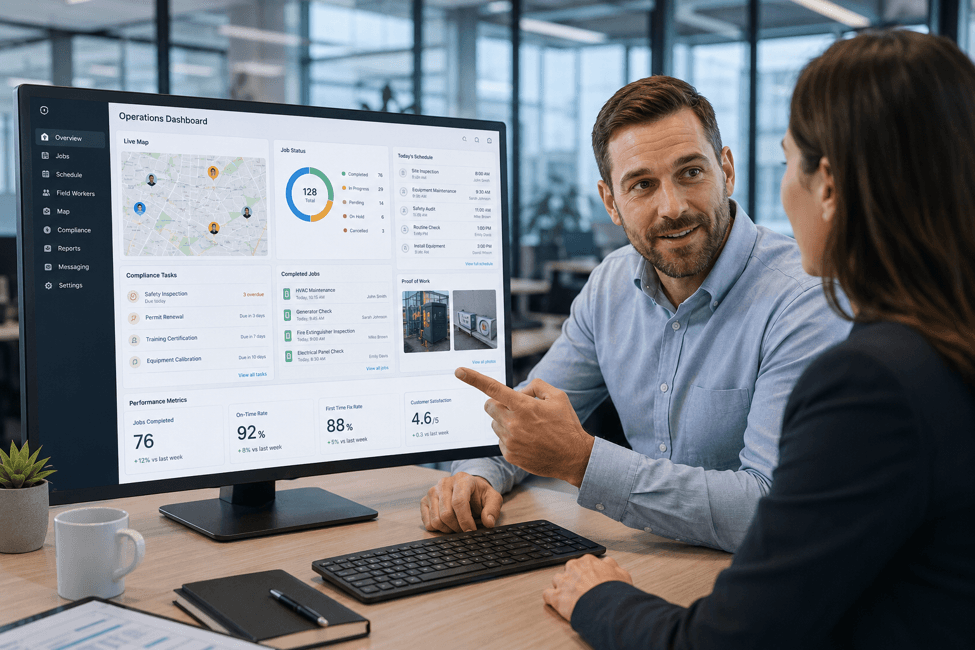
In practice, that consolidation tends to look like this:
A single dashboard for the whole operation
Instead of checking six places to understand what is happening, a manager opens one dashboard and sees task assignment, scheduling, messaging and job completion in the same view. Availability and workload sit together, rather than living in separate systems that never quite agree with each other.
Live visibility instead of phone calls
Rather than relying on someone to pick up the phone, managers can see exactly where every field worker is, in real time. Knowing who is on site, who is en route, and who has just finished a job stops being a question that needs answering, because the answer is already visible.
Proof of work that arrives automatically
Photos, videos, signatures and completed forms move directly into the platform from the field, automatically timestamped and location-verified. There is no longer a gap between a job being finished and the evidence of that job existing somewhere usable.
Safety built into daily operations, not bolted on
Instead of a missed WhatsApp message standing in for a safety protocol, live tracking and one-tap emergency alerts give managers real visibility without needing to interrupt a worker who is mid-job. If something goes wrong, the right people know immediately.
Administrative work that runs itself
Attendance, payroll calculation, invoicing and reporting, which often exist as separate manual processes layered awkwardly on top of the operational work, connect to the same underlying data. The Friday afternoon spent reconciling timesheets against a spreadsheet largely disappears.
A gradual transition, not a forced switch
The businesses doing this well are not ripping everything out overnight. The strongest platforms integrate with the tools already in use, such as WhatsApp, Slack, Microsoft Teams and Google Workspace, so teams keep working in familiar ways while gradually shifting their dependence onto the unified system.
What this actually looks like, day to day
It is worth being concrete about what changes for the person actually running the operation, because the difference shows up most clearly in the shape of an ordinary day.
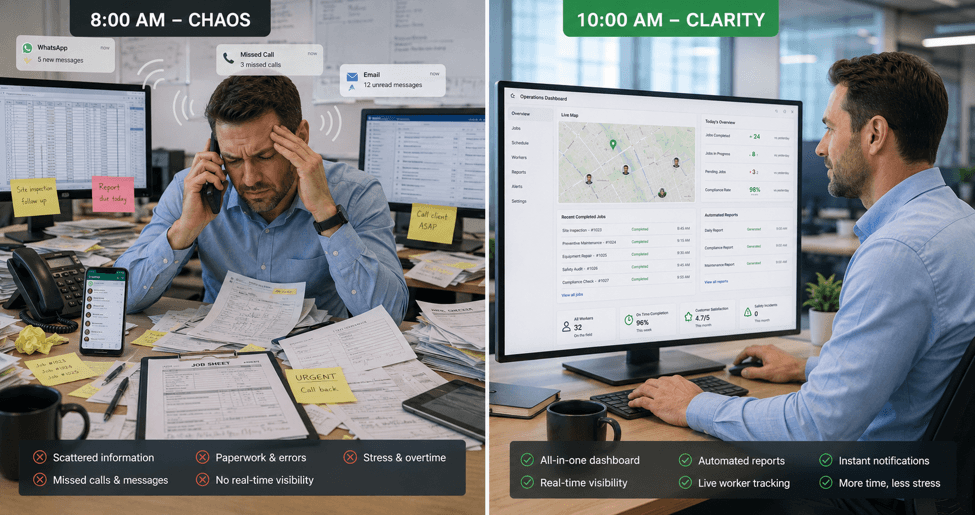
Before this shift, the morning typically starts with a round of calls to confirm who has turned up, a scroll through a WhatsApp group to see if anything was flagged overnight, and a spreadsheet update logging who is covering which site. Updates trickle in unevenly through the day, some by message, some by call, some not at all until someone is asked directly. By the time a report is needed at the end of the week, putting it together is itself a small project, pulling information from several places and hoping nothing has been missed.
After the shift, the same manager opens one dashboard each morning and immediately sees who is on duty, where every field worker currently is, and whether anything needs urgent attention. Tasks are assigned and tracked in the same place workers receive and complete them. Evidence of completed work arrives automatically, verified and timestamped, with nobody needing to chase it. If a worker needs help, an alert reaches the right people instantly, rather than depending on someone happening to notice a missed message.
The work itself has not changed. What has changed is how much of the manager's time goes toward simply finding out what is happening, rather than deciding what to do about it.
What to look for before making the switch
Not every platform marketed as "unified" actually replaces the underlying problem. A few things are worth prioritising over a long feature list.
Look for a platform built around how your operation actually works, rather than one that expects you to bend your business to fit the software. The strongest platforms flex to handle industry-specific realities, whether that is subcontractor management, compliance documentation or client-specific reporting formats.
Prioritise safety functionality that is genuinely fast and reliable, not just present on a features page. Live tracking and emergency alerts only matter if field workers actually use them without a second thought.
Pay attention to how much manual admin is actually removed, rather than simply displayed differently. A platform that shows your six tools inside one dashboard has not solved the underlying problem. A platform that automates attendance, payroll and reporting has.
And think carefully about adoption. The best system in the world delivers nothing if field workers find it complicated or intrusive. The platforms succeeding at this shift tend to be the ones that feel as straightforward on a worker's phone as the consumer apps they already use every day.
How to tell if your business is ready for this shift
A simple way to check is to ask three questions:
How many tools does a field worker need to access to complete a single job, from assignment to invoice?
How many of those tools are used by subcontractors and freelancers, and does that differ from what direct staff use?
If a field worker needed help right now, what would actually happen, and how confident are you that it would work?
If those answers feel uncomfortable, that discomfort is useful information. It is pointing directly at the gap between the operation your business currently has and the one it is capable of running.
Frequently Asked Questions
What is a field operations platform?
A field operations platform is a unified system that manages the full workflow of a business with a distributed workforce: from task coordination and live tracking to job completion, safety alerts and reporting. Unlike general-purpose tools such as WhatsApp or Microsoft Teams, it is built specifically for the structure and pace of field-based work.
Is this just about replacing WhatsApp?
No. WhatsApp is usually the most visible symptom of the problem, but the real shift is about replacing an entire scattered stack—communication, scheduling, proof of work, safety and admin—with one connected system. Removing WhatsApp without addressing the rest of the stack only solves a small part of the issue.
How disruptive is moving to a unified platform?
It does not need to be highly disruptive. The strongest platforms integrate with tools already in use, so teams can keep working in familiar ways at first while gradually consolidating onto the unified system. A gradual transition tends to see far higher adoption than a forced, overnight switch.
What is the biggest sign a business is ready to consolidate?
The clearest sign is when a manager can no longer answer a basic operational question, such as who is on site right now, without making several calls or checking multiple tools. At that point, the cost of staying fragmented has usually already overtaken the cost of switching.
Does consolidating tools also improve safety?
Often significantly. Most fragmented setups rely on personal messaging apps for field safety by default, simply because nothing else is in place. A unified platform with live tracking and instant alerts gives managers a genuine safety baseline that a missed WhatsApp message never could.
What should a business look for when evaluating a unified platform?
The most important criteria are real-time field visibility, reliable safety features, the ability to manage subcontractors and freelancers alongside direct staff, and how much manual admin the platform genuinely automates rather than simply displays. Ease of adoption matters just as much—a platform only delivers value if the field team actually uses it.
See how we bring it all together
PressHop® Enterprise is a field operations platform, built specifically for businesses managing field workers, subcontractors and operational workflows at scale. One dashboard replaces the fragmented stack, without forcing you to abandon the tools you already use overnight.
If your business is still running across six different tools, it's worth ten minutes of your time to see what a unified approach looks like.
Book a quick demo at presshop.com/enterprise/book-demo