


Ritchie Nanda · 41 minutes ago · 5 min read
The hidden cost of managing teams on WhatsApp, emails, phone calls and spreadsheets
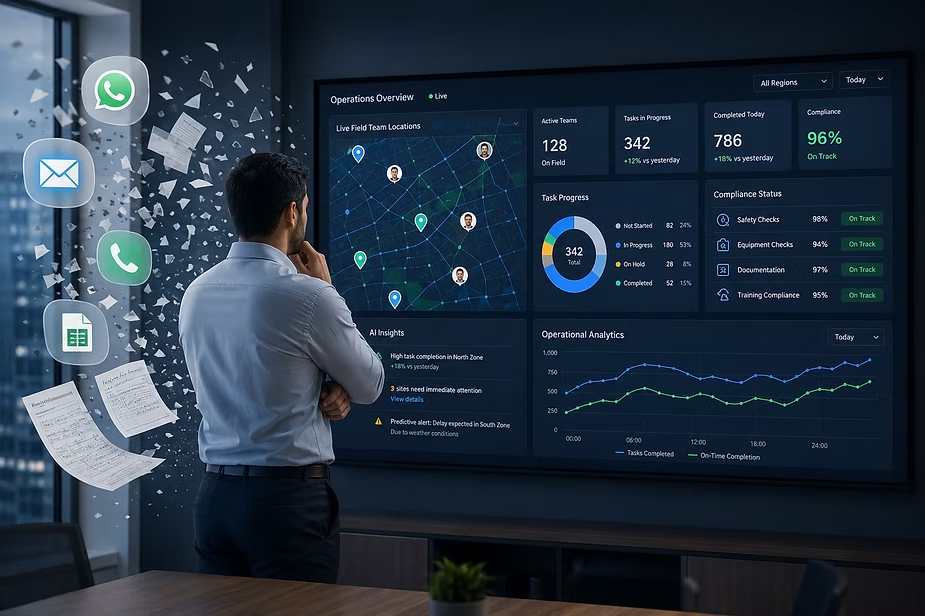
Many businesses don't realise they're running critical operations through a patchwork of disconnected tools.
A job is assigned on WhatsApp. An update arrives by email. A manager follows up with a phone call. Attendance is logged in Excel. Reports are completed on paper before someone manually transfers the information into another spreadsheet.
Each tool works well in isolation. Together, however, they create operational complexity, reduce productivity and increase costs..
This challenge affects organisations across construction, facilities management, security, logistics, utilities, insurance, healthcare and field services. As teams become more mobile and customer expectations continue to rise, fragmented communication creates delays, duplicate work and a lack of operational visibility.
Increasingly, organisations are replacing disconnected software with field operations software, workforce management software and AI-powered operating systems that connect people, processes and data in one place.
Why businesses still use WhatsApp, emails and spreadsheets
Most organisations didn't intentionally create fragmented operations. Their processes evolved over time.
WhatsApp became the quickest way to contact employees. Email remained the formal communication channel. Excel tracked schedules and payroll. Phone calls handled urgent issues. Paper forms captured compliance information on-site.
Increasingly, organisations are replacing disconnected software with field operations software, workforce management software and AI-powered operating systems that connect people, processes and data in one place.
Initially, these tools were inexpensive, familiar and easy to adopt.
The challenge appears as businesses grow.
More employees mean more conversations, more spreadsheets, more documents and more manual coordination. Managers spend increasing amounts of time chasing updates instead of making decisions.
Instead of one connected workflow, information becomes scattered across multiple systems that don't communicate with each other.
The hidden costs of fragmented operation
The financial impact of disconnected operations is often invisible because it appears in small daily inefficiencies rather than one large expense.
Common problems include:
Managers repeatedly chasing job updates.
Employees searching multiple conversations for information.
Duplicate data entered into different systems.
Spreadsheet errors requiring manual correction.
Missed customer deadlines due to poor communication.
Missed customer deadlines due to poor communication.
Delayed approvals affecting project delivery.
Reduced accountability when decisions aren't recorded centrally.
For example, a facilities management company may receive a maintenance request by email, assign it through WhatsApp, confirm completion via a phone call and update the spreadsheet later that day.
Every handoff introduces opportunities for delays, misunderstandings or missing information. Individually these delays appear insignificant. Across hundreds of jobs every week, they become a substantial operational cost.
Traditional vs connected operation
| Activity | Traditional process | Connected operations platform |
| Job allocation | WhatsApp messages | Instant task assignment |
| Attendance | Paper registers | GPS and mobile check-ins |
| Site reporting | Photos via WhatsApp | Time-stamped digital reports |
| Compliance | Email attachments | Automated compliance records |
| Payroll | Manual spreadsheet calculations | Automated workforce data |
| Communication | Calls, texts and emails | Unified team communication |
| Proof of work | Separate photos and documents | Centralised proof with location, timestamps and media |
A connected operations management platform reduces manual administration while improving accuracy and visibility.
Why WhatsApp alone was never built to run a business
WhatsApp is an excellent messaging application, but it was never designed to operate businesses.
Businesses require structured workflows, accountability and audit trails rather than simple conversations.
Key limitations include:
- No approval workflows.
- No operational dashboards.
- No workforce reporting.
- No GPS verification of completed work.
- No integrated employee scheduling.
- Limited search across large operational histories.
- No automated compliance records.
- No operational analytics.
A message confirming a completed task is not the same as verified proof of work.
Modern field service software captures timestamps, GPS location, photos, digital signatures and completion records automatically, creating reliable operational evidence.
This becomes increasingly important in industries where compliance, customer disputes and service-level agreements depend upon accurate documentation.
What modern businesses are doing instead

Organisations are moving away from isolated applications towards integrated business operating systems that connect operations across departments.
Instead of switching continuously between messaging apps, spreadsheets, payroll systems and reporting tools, businesses are consolidating workflows into one connected environment that brings these tools together for greater efficiency and ease of use.
Modern AI operations platforms typically provide:
- Live operational visibility.
- Mobile workforce management.
- Employee scheduling.
- Automated workflow approvals.
- AI-generated reporting.
- Compliance management.
- Asset tracking.
- Operational intelligence.
- Proof of work verification.
- Performance dashboards.
This shift isn't simply about replacing software.
It's about improving workforce productivity, reducing operational risk and enabling managers to make faster decisions using real-time information instead of manual updates.
As organisations continue their digital transformation, connected operational platforms are becoming the new standard for managing distributed teams.
Frequently asked questions
Why is WhatsApp not suitable for managing field teams?
WhatsApp is designed for messaging, not operations management. It lacks workflow automation, audit trails, reporting, GPS verification, compliance tracking and proof of work, making it difficult to manage business-critical processes at scale.
What is field operations software?
Field operations software is a platform that helps organisations schedule work, manage mobile employees, capture proof of work, monitor performance and coordinate field activities from one central system.
What is an AI-powered operating system for businesses?
An AI-powered operating system combines communication, workflows, reporting, automation and operational intelligence into one connected platform, helping businesses improve productivity and decision-making.
How do businesses improve operational visibility?
Businesses improve operational visibility by replacing disconnected communication tools with integrated operations management platforms that provide live updates, workforce tracking, reporting and real-time dashboards.
What is proof of work software?
Proof of work software verifies completed tasks using evidence such as GPS location, timestamps, photographs, videos, signatures and digital records, helping organisations improve accountability and compliance.
How can businesses improve workforce productivity?
Businesses improve workforce productivity by reducing manual administration, automating repetitive tasks, centralising communication and giving managers real-time visibility through modern workforce management software.
The future of business operations
The future of business operations isn't about replacing WhatsApp with another messaging app or spreadsheets with another reporting tool. It's about moving beyond disconnected software altogether.
As organisations grow, relying on separate tools for communication, scheduling, reporting, compliance and workforce management creates unnecessary complexity. Information becomes fragmented, visibility decreases and valuable time is lost switching between systems instead of making informed decisions.
This is why many businesses are moving towards unified, AI-powered business operating systems that bring workflows, communication, assets and operational intelligence together in one connected platform. Rather than managing multiple separate applications, organisations gain a single source of truth with real-time visibility, automation and greater operational control.
This shift has led to the emergence of platforms such as CEREBERA.
CEREBERA is the world's most affordable AI-powered Operating System for modern businesses, powering a family of intelligent operating systems across multiple industries. Whether it's managing operations, coordinating people, automating workflows, tracking assets or overseeing field teams, CEREBERA brings every part of an organisation together through one connected ecosystem.
Built to make enterprise technology more accessible, it helps organisations simplify complexity, improve productivity and scale without the cost and limitations of traditional enterprise software.
As businesses continue their digital transformation, connected operating systems are becoming the next evolution of enterprise technology, enabling organisations to work smarter, respond faster and grow with confidence.
CEREBERA offers an integrated Communications Hub that connects tools like WhatsApp, Slack, Microsoft Teams, Gmail, Outlook and others into one connected dashboard so that no communication gets lost whilst switching between platforms. Want to learn more? Book a demo now at cerebera.com/demo to see what the Communications Hub can do for you.